Cairn.
Personal productivity SaaS with a context-aware AI assistant
· Last updated 2026-03-20Cairn is a freemium productivity SaaS I designed and built from scratch. Most productivity apps make you manage the app, not your work—Cairn gives you one screen for what matters today, connects daily tasks to quarterly goals, and drafts your weekly reviews from your own data with an AI assistant that has full context. 30 routes across marketing, authed app, billing, and an admin surface. Installable as a PWA with web-push habit reminders. Shipped with Paystack for Ghana local billing in GHS.
TL;DR
Cairn is a freemium daily productivity SaaS engineered with Next.js 16, local-first Zustand, and a Google Gemini streaming assistant. It combines daily tasks, quarterly goals, and automated weekly reviews with Paystack GHS billing.
Key Facts & Specifications
| Role & Scope | End-to-end ownership—product, design system, full-stack Next.js, AI integration with Google Gemini, Paystack subscriptions, Cloudinary uploads, VAPID web push, service worker, and production docs. |
|---|---|
| Tech Stack | Next.js 16, React 19, TypeScript, Tailwind CSS v4, Zustand (persist), Motion, Lucide, Google Gemini 2.5 Flash, Resend, Paystack (GHS), Cloudinary, Web Push + VAPID, Service Worker (custom), Zod, date-fns |
| Status | Beta |
| Key Metrics | Pricing: Free + GH₵70/mo or GH₵640/yr · Themes: 5 (OKLCH based) · Routes: 30+ across marketing, app, API · AI provider: Google Gemini 2.5 Flash · Payments: Paystack (GHS) · PWA: Installable + offline shell · Push notifications: Web Push (VAPID) · Status: Beta |
| Primary Links | Live Product ↗GitHub Repository ↗ |
Results & Key Metrics
Pricing
Free + GH₵70/mo or GH₵640/yr
Themes
5 (OKLCH based)
Routes
30+ across marketing, app, API
AI provider
Google Gemini 2.5 Flash
Payments
Paystack (GHS)
PWA
Installable + offline shell
Push notifications
Web Push (VAPID)
Status
Beta
Product Interface
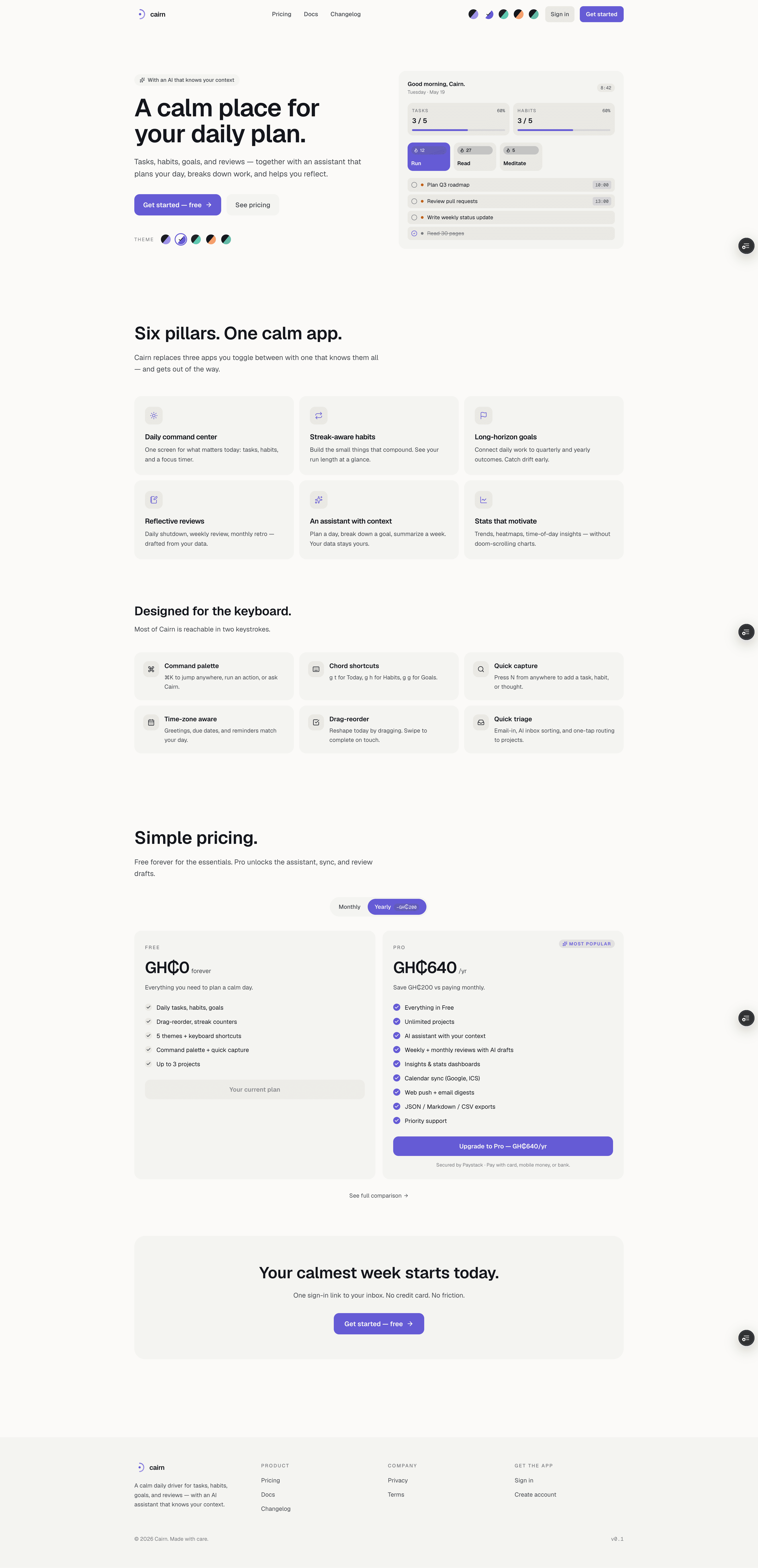
Today view—tasks, habits, focus timer, and a daily quote on one screen with full keyboard navigation.
Engineering Scope
End-to-end ownership—product, design system, full-stack Next.js, AI integration with Google Gemini, Paystack subscriptions, Cloudinary uploads, VAPID web push, service worker, and production docs.
Technology Stack
- Next.js 16
- React 19
- TypeScript
- Tailwind CSS v4
- Zustand (persist)
- Motion
- Lucide
- Google Gemini 2.5 Flash
- Resend
- Paystack (GHS)
- Cloudinary
- Web Push + VAPID
- Service Worker (custom)
- Zod
- date-fns
What I Built & Technical Decisions
Local-first architecture—Zustand with persist middleware as single source of truth across pages. Every mutation runs synchronously; no network round-trips block the UI. The action API is shaped so a future DB swap (MongoDB / Postgres) replaces only the action bodies, not component contracts.
Custom design system instead of a UI library—five themes via CSS variables (OKLCH), zero borders / blur / glass / colored shadows. Includes hand-built DatePicker, TimePicker, Select, Modal, Popover, and a ~80 LOC markdown renderer to keep the bundle tight.
Streaming AI with classified errors—every AI surface (chat, plan my day, goal diagnose, task breakdown, note assistant) streams Gemini responses via ReadableStream. Errors are mapped to typed kinds (no_credit / rate_limit / auth / overloaded) and rendered as markdown inside the same stream, so the UI never has to handle a separate error path.
Keyboard-first interaction—⌘K command palette with fuzzy matching, chord nav (g t for Today, g j for journal), quick add (N), cheatsheet (?), and per-modal focus traps. Every native form control replaced with custom primitives so the experience is identical across browsers and themes.
Paystack billing in GHS—Pro at GH₵70/mo or GH₵640/yr (saves GH₵200). HMAC SHA512 webhook signature verification with timing-safe compare; invoice list pulled live from the Paystack API.
The Problem & Architecture Challenge
A local-first store powered by Zustand persist creates a server/client hydration mismatch on every authed page: the server has no localStorage, so it renders the seed; the client rehydrates and renders the user's real data. React flags this as a hydration error and discards the tree.
Built a 30-line Hydrated wrapper at the layout level that renders a structural skeleton on both the server and the first client paint, then swaps to children after the store rehydrates. No mismatch, no flash, one render. The same primitive removes a whole class of bugs across every store-backed page.
Production Reality & Resolution
What Broke & How It Was Resolved
Pre-launch beta—actively used for personal daily planning. Service worker initially intercepted /api/* during PWA install, briefly breaking the streaming AI responses. Fixed by adding an explicit URL path check in the SW fetch handler and version-prefixing every cache so old caches purge cleanly on each new deploy.
Roadmap & Next Iterations
Wire MongoDB for cross-device sync and persistent push subscriptions. Ship Google Calendar / ICS sync. Add a Vercel Cron job for goal-at-risk nudges (the endpoint is already wired). Add MFA. Move soft-delete retention enforcement from client-side to a server-side cron once the DB lands.
Previous Case Study
99Solar Automated Bidding ToolNext Case Study
AllMapHostels